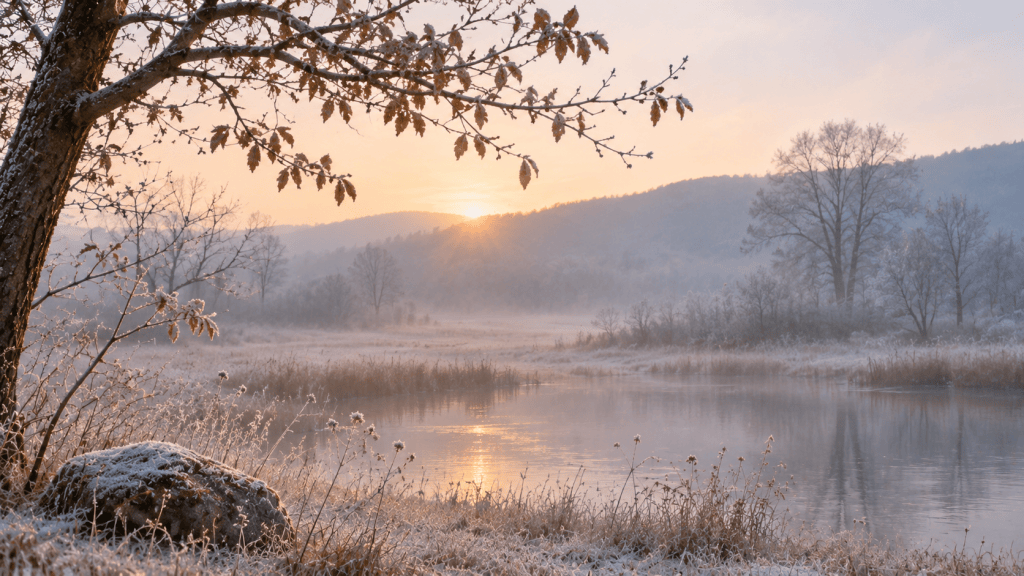
The Beginning of Winter
Winter begins before we think it does.
In the Western calendar, winter arrives with the solstice in December. But in the traditional Chinese calendar, winter begins much earlier, around November 7, with 立冬 (Lì Dōng).
立 means to establish, to stand, or to begin. 冬 means winter.
Yet 立冬 is not simply the announcement of cold weather. It marks a turning in the movement of nature—a change that has already begun, whether or not we have noticed it.
The Movement of Yin and Yang
Throughout the year, nature moves through an endless interplay between 陰 (Yīn) and 陽 (Yáng).
Spring brings forth life. Summer expands and flourishes. Autumn gathers and releases. Winter returns inward.
By the time 立冬 arrives, the expansive movement of Yang has largely retreated. Yin grows deeper, drawing life toward stillness, concealment, and conservation.
Look at the trees. Their leaves have fallen, yet they are not dead. Life has simply withdrawn from what is visible.
Look at the earth. Beneath the quiet surface, roots remain alive, seeds rest, and unseen processes continue.
Winter is not the absence of life. It is life gathered within, preparing to be born anew when spring arrives. Each ending holds the seed of another beginning.
The beginning is the end, and the end is the beginning.
冬藏 · The Wisdom of Storage
Traditional Chinese philosophy speaks of the seasons through four movements:
春生 · Spring gives birth
夏長 · Summer brings growth
秋收 · Autumn gathers
冬藏 · Winter stores
The word 藏 (cáng) is especially important.
To store is not merely to accumulate. It is to discern what is precious and release what is no longer needed. Perhaps it is no coincidence that 藏 also appears in the word 寶藏 (bǎozàng)—treasure.
Storage, then, is not about holding on to everything. It is about recognizing what is worth preserving and allowing it to remain undisturbed until the proper time for its expression.
The Huangdi Neijing (黃帝內經) describes winter as 閉藏, a season of closure and storage.
We are encouraged to retire early, rise later, avoid unnecessary exposure to the cold, and refrain from disturbing our Yang energy.
But these teachings are not meant to be restrictive.
Too often, even within Chinese traditions, ancient wisdom becomes misunderstood or misapplied as a collection of rigid rules. What began as an invitation to live in harmony with nature becomes a prescription for what one must or must not do.
The deeper teaching is about attunement—to the season, to the movement of the sun, and to the rhythms of life within and around us.
Sometimes a plunge into the cold waters of a beautiful spring is exactly what is called for, followed by a toasty moment beside a warm fire.
Wisdom lies not in mechanically following rules but in recognizing what the moment asks of us.
It is reverence, not dogma.
And these teachings extend far beyond our physical habits.
How much of our energy do we spend explaining ourselves, proving ourselves, pursuing things, or responding to every movement around us?
What would happen if, for a season, we allowed something within us to remain quiet?
Not everything needs to be expressed. Not every thought needs to be spoken. Not every seed needs to sprout immediately.
There is wisdom in allowing things to remain unfinished.
Returning to the Root
In Daoist thought, returning is not regression. It is part of the natural movement of life.
A tree does not struggle to hold its leaves through winter. It releases them and draws its vitality back toward the roots.
We, too, have roots.
But in the noise and urgency of daily life, it becomes easy to live entirely in our branches—our activities, achievements, relationships, opinions, and obligations.
Winter invites us to return to what sustains us beneath all these expressions.
In Chinese medicine, winter corresponds to the Water phase (水) and the Kidneys (腎), associated with the preservation of 精 (Jīng), often translated as essence.
Water seeks the low places. It settles. It gathers. It does not need to announce its strength.
Perhaps there is something we can learn from this.
Practicing 立冬
We do not need elaborate rituals to enter a season consciously.
We can begin with a few simple gestures.
Rest a little more. Allow the body to respond to the diminishing daylight. Rest is not something we must earn through exhaustion.
Nourish warmth. Enjoy warm meals, soups, and gently cooked foods. Notice what genuinely nourishes rather than merely fills.
Practice quiet. Spend a few minutes each day without speaking, reading, listening, or reaching for a device. Let the mind settle without demanding that it become still.
Gather what matters. Ask what you wish to preserve through the coming winter. It may not be a possession or accomplishment. It may be a relationship, a quality of heart, or a quieter way of living.
Release what need not follow you. There is no need to carry every argument, disappointment, or unfinished ambition into the next season.
These are not rules to follow, but invitations to explore. The practice is not in doing them perfectly, but in becoming more attentive to our own rhythms.
A Season Within Us
The seasons do not belong only to the landscape.
There is spring within us whenever something begins. Summer when we grow and express. Autumn when we discern and release. And winter when we return to silence.
Perhaps this is why the ancient Chinese observed nature so closely—not merely to predict the weather or organize agricultural life, but to recognize the movements of life itself.
Today, as we enter 立冬, perhaps we can resist the temptation to ask what more we should do.
Instead, we might ask:
What within me is ready to become quiet?
What deserves to be protected and nourished?
And what might grow, unseen, if I simply allow it to rest?
立冬安好。
May this beginning of winter bring us closer to our roots.


Leave a Reply